
When Books Disappear, So Do Stories: The Fight Against Book Banning
If you remove books from library shelves, children lose access to them. What do we call that? Banning.
That's exactly what happened at North Woods School in Cook, Minnesota, where more than 80 books were pulled from the school library in October 2025.
Here are some of the titles reported:
Gender Queer by Maia Kobabe
Charlotte's Web by E.B. White
A Wrinkle in Time by Madeleine L'Engle
John Deere Farm-to-Table Cookbook for Kids
Reporting also describes books addressing LGBTQ+ themes, racism, and the Holocaust, alongside children's classics, Newbery Award winners, bedtime stories, and books by Native American authors.
A complete list of all 80 books hasn't been published, so these are among the confirmed titles.
Now, here's a question: What do these books have in common?
I'll let you think about that for a moment.
But aren't schools within their rights to remove books?
Not simply because they disagree with the ideas or perspectives presented in them.
In 2024, Minnesota passed a law establishing protections against removing library materials solely because of the ideas or opinions they express.
So, how did this happen anyway?
According to PEN America, Minnesota recorded 80 instances of book bans during the 2025–2026 school year, and all 80 came from North Woods School. Wisconsin and North Dakota reported zero during that period.
What's even more concerning is that reporting indicates the books were never reviewed afterward. In other words, they've remained inaccessible since their removal.
Let's take a look at some of the books being challenged by several states (Texas, Florida, Arkansas, Iowa, Oregon, Utah, Alabama) and lawmakers.
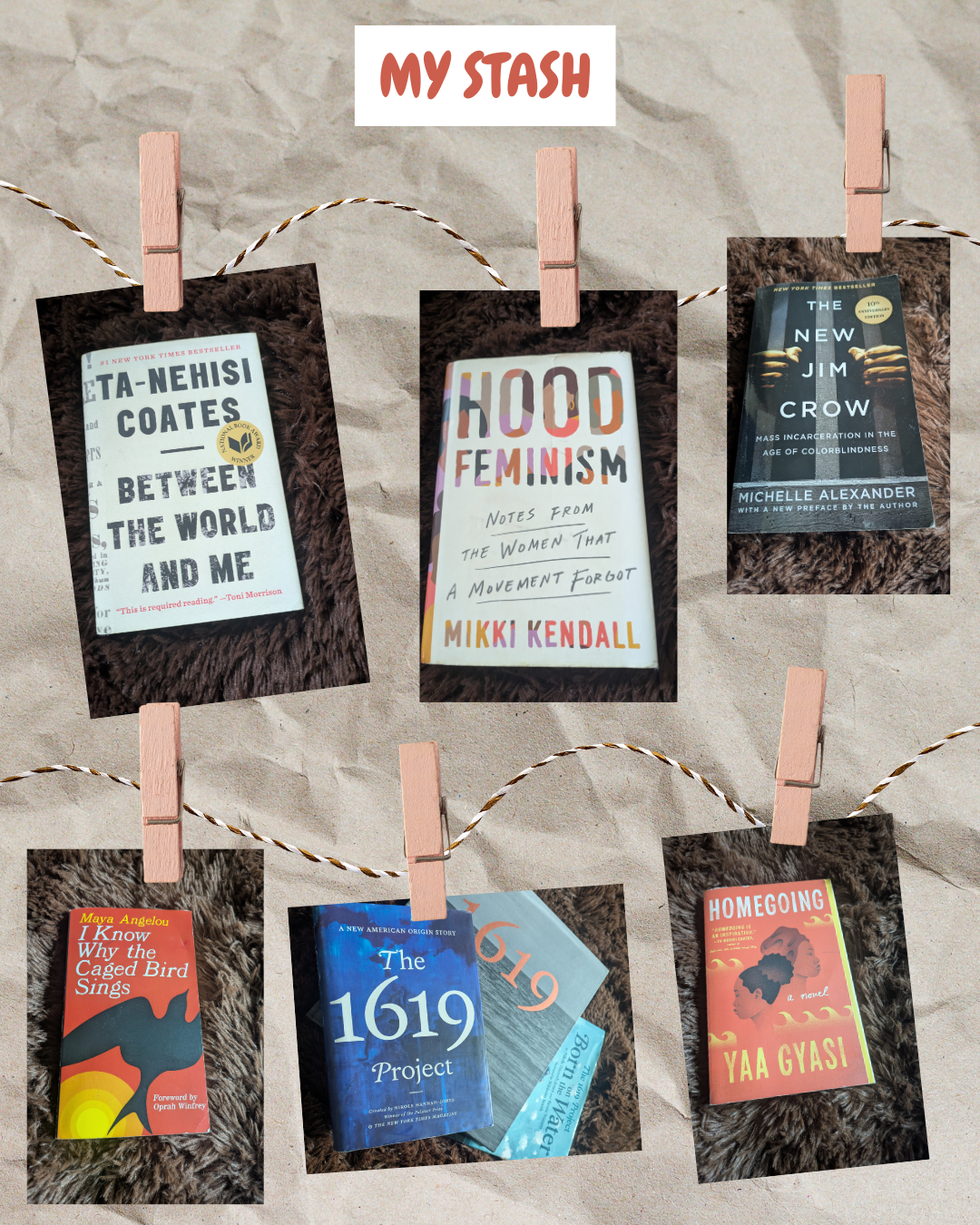
My Stash
I own and have read some of these books, and honestly, I struggle to understand why anyone would want to ban them. Some of these titles should be required reading.
The 1619 Project belongs in every household, in my opinion, and deserves to be revisited every year. (Which reminds me, I need to schedule another read with the kids!)
The New Jim Crow provides an important perspective on the American legal system. And frankly, looking at where we are today, I'm not convinced we've evolved as much as we'd like to believe.
Between the World and Me? What's the problem?
The same goes for The Color Purple, Homegoing, and I Know Why the Caged Bird Sings.
These are books that encourage critical thinking, challenge assumptions, preserve history, and introduce readers to experiences beyond their own.
Maybe I'm taking this too personally, but sometimes it feels like more than an attack on books. It feels like an attack on our stories, our history, and our right to be represented.
And the numbers make that feeling difficult to ignore.
The numbers tell a bigger story
A peer-reviewed study examining 2,532 book bans nationwide during the 2021–2022 school year found that 59% of the banned books were children's books featuring diverse characters or nonfiction titles about historical figures and social movements.
Even more striking, authors of color wrote 39% of the banned titles, despite representing only about 10% of U.S. authors.
Let that sink in.
That's bananas, but it's true.
When we look at which stories are being challenged, we have to ask ourselves some uncomfortable questions. Whose experiences are considered appropriate for children to read about? Whose history deserves space in a classroom? And whose stories are being pushed out of the conversation?
This is bigger than 80 books
At the end of the day, this isn't just about 80 books sitting somewhere outside a school library.
It's about who gets to see themselves represented on the shelves and who gets erased from them.
Children deserve libraries that tell the truth, preserve their stories, and open doors to worlds and experiences they may never have encountered otherwise.
Banning books doesn't protect children. It limits what they can learn, imagine, question, and understand.
Minnesota already has a law designed to protect access to library materials. But laws only mean so much if we don't hold institutions accountable for following them.
So, what can we do?
- Visit your local library and read some of the books on these lists.
- Keep diverse books in your children's reading routines.
- Show up at school board meetings and ask questions about what's available in school libraries.
- Have conversations with your children about the books they read and the stories they encounter.
- Support authors, educators, and organizations working to protect access to diverse literature.
Because if we stay quiet, the next 80 won't be the last.
Why Curriculum and Culture matters?…
This is exactly why Curriculum and Culture exists.
Access to diverse books shouldn't be occasional, and conversations about history, identity, culture, and representation shouldn't happen only when something makes the headlines.
When we make diverse books part of our children's everyday reading routines, encourage curiosity, and keep meaningful conversations flowing, we help them develop the critical thinking skills they need to navigate the world around them.
We also take another step toward addressing the literacy crisis by helping children become engaged, confident, and curious readers.
Books are more than words on a page. They are mirrors, windows, and doors.
Let's make sure our children have access to all three.
What do you think? Should any of these books be removed from school libraries? Have you read any of the titles mentioned? I'd love to hear your thoughts in the comments.
Sources
80 books removed, firing, Minn. Stat. 134.51: The Timberjay. http://www.timberjay.com/stories/new-focus-on-north-woods-book-banning,46811
Removal timing (week of Oct. 5), 2024 Access to Library Materials law: Duluth News Tribune. https://www.duluthnewstribune.com/news/local/following-library-controversy-st-louis-county-schools-moves-to-adopt-new-policy
Minnesota 80 bans, zero in Wisconsin and North Dakota: Fox 9, citing PEN America. https://www.fox9.com/news/how-many-books-were-banned-your-state
59% finding: study authors via Mississippi Free Press. https://www.mississippifreepress.org/?p=49645
39% and 10% findings, 32 states: study authors via Truthout and ArcaMax. https://truthout.org/articles/book-bans-overwhelmingly-target-childrens-books-by-people-of-color-study-finds/ and https://arcamax.com/politicalnews/s-3481839
Study itself (PNAS Nexus): https://pmc.ncbi.nlm.nih.gov/articles/PMC11165646/
PEN America report: https://pen.org/report/book-bans-spotlight-2026/
